The Girl who Dreamed of Wimbledon from the Shellcourts in Pasig
The best story in tennis right now isn’t about Djokovic, Alcaraz, or Swiatek. It’s about a twenty-year-old from Quezon City who trained for five years on Rafa Nadal’s clay in Mallorca and is now ranked among the thirty best players on earth. Her name is Alex Eala. This is her story.
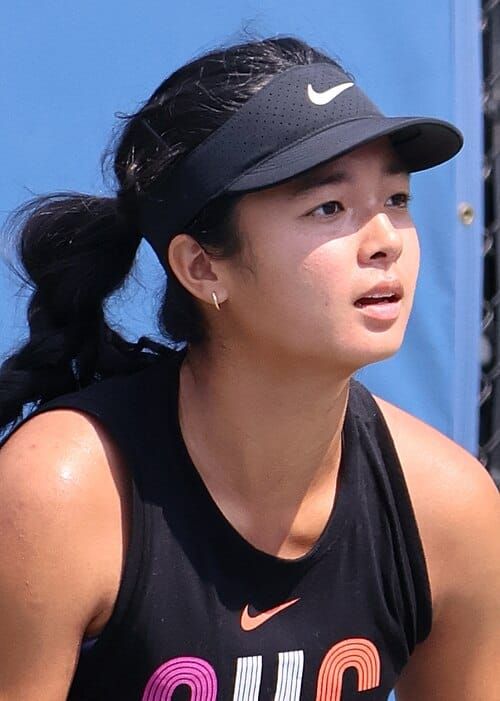
Alex Eala (2024 US Open) by Hameltion is licensed under CC-BY-SA-4.0 on Wikimedia CommonsThe Alex Eala Story
A Philippine Love Story · A Minibook · April 2026
The Alex Eala Story
From shell courts in Pasig to the biggest stages on earth. How a girl with a racket nearly her own size became the most beloved name in tennis.
“There are 115 million Filipinos and I am the first tennis player in history. It’s so crazy.”
— Alexandra “Alex” Eala · São Paulo · 2025
I
Chapter One · Pasig City, Philippines
Shell Courts & Sunsets
Bobby Maniego was not supposed to be a tennis coach. He was barely even a tennis player, frankly — a club member who loved the game the way certain retired men love things: deeply, privately, with a small stack of books about it on the nightstand. He was the kind of person who showed up at Valle Verde Country Club in Pasig City before anyone else arrived, not because he had lessons to give but because the hard courts filled up fast, and he had a theory.
The theory was this: the courts at Valle Verde were surfaced in crushed shells. Beautiful surface, soft on the knees, uniquely Filipino. Also completely useless as preparation for international competition, because nobody else in the world plays on shells. So every morning before his granddaughter got out of school, Bobby Maniego went to the club and waited. He claimed a hard court for her. He waited for as long as it took. Then she arrived, four years old, with a racket nearly as tall as she was, and he fed her balls until the light went bad.
That is where this whole story begins. Not in New York or Miami or Mallorca. In Pasig, on a hard court that an old man waited for all morning, feeding balls to a child who never once looked like she was just playing.
He used to say: outside the Philippines there are no shell courts. If they wanted to compete abroad, they had to learn on hard courts.
— Roberto “Bobby” Maniego, Alex’s Lolo, as recalled in interviews
Alexandra Maniego Eala — Alex — was born May 23, 2005, in Quezon City. Her mother Rizza had been a national swimmer, bronze medal at the 1985 SEA Games in the 100-meter backstroke. Her father Mike ran businesses. Her uncle Noli would eventually chair the Philippine Sports Commission. Her brother Miko would play collegiate tennis for Penn State. Sport was not a hobby in the Eala house. It was the first language. Tennis just turned out to be the one Alex spoke loudest.
📰 A Reporter Remembers — Dyan Castillejo, Philippine Daily Inquirer
In 2015, sportswriter Dyan Castillejo had just been briefed on multimedia coverage at the Inquirer and was practicing on her iPhone. She found herself at Court 4 of the Rizal Memorial Tennis Center in Manila, filming a junior match nobody had told her to watch.
The girl on court was ten years old. “She never smiled even after winning the match,” Castillejo wrote later. “Her focus was laser-like. All this time, that dusky, intense young gal never bothered to look at this reporter.” Mike Eala, watching cross-legged in the wooden gallery, noticed Castillejo and came over. They exchanged numbers. Castillejo has been covering Alex ever since.
Years later, when she finally told Alex about that afternoon on Court 4, Alex went quiet for a beat. Then: “Was I wearing a purple dress that day?”
What She Was Made Of
She grew up without a Filipino tennis player to model herself on. Not one. When she looked for someone who had done what she wanted to do — from the Philippines, playing professionally on the tour — there was nobody. So she borrowed from whoever she could. She watched Sharapova for the aggression, the flat, chest-high groundstrokes hit like she was annoyed at the ball. She watched Li Na because Li Na was Asian and that mattered, practically and emotionally, in ways she did not always explain but clearly felt. She watched Nadal because he was left-handed and because watching Nadal — the way he fought for points that were already lost, the way he treated every rally like it was the last one — is basically a tennis education by itself.
“I don’t think you should be limited by the representation you see to take inspiration,” she has said. Easy enough to say. Harder to actually do, at eight years old, when there is genuinely no one who looks like you doing what you want to do. But she did it. And then she became the representation she never had.
II
Chapter Two · Tarbes, France · January 2018
The Twelve-Year-Old Champion
Les Petits As is held every January in Tarbes, a city in the French Pyrenees that is most famous, in tennis circles, for being the place where everything starts. It is the unofficial world championship for players fourteen and under, and its alumni list reads like a warm-up act for the Tour: Federer won it, Nadal won it, Henin won it. The pressure in the draw is absurd for the ages involved. Kids arrive from forty countries with full coaching teams and fully formed games. Wild cards, by definition, don’t usually win it.
Alex Eala arrived in Tarbes in January 2018 as a wild card. She was twelve. She was from the Philippines. She did not lose a set.
The final was against Linda Noskova, the Czech prodigy who would go on to crack the WTA’s top fifteen. Alex won 5-7, 6-3, 7-6. Three sets. The Czech took the first; Alex came back and won the next two. The Rafa Nadal Academy, which had been watching, called with an offer: full scholarship, come to Mallorca. The family flew to Spain to see the place. On the way there, at the airport in Madrid, something happened.
She moved to Spain at thirteen. Thirteen. Her brother Miko was with her, which helped — but no parents, no Tagalog-speaking coaches, no Filipino food. Just the academy, the Mediterranean, the clay courts, and whatever reserve of stubbornness she had brought from home, which turned out to be considerable. She missed what teenagers miss when they’re not around other teenagers — the hanging out, the doing nothing, the particular social education of just being young with other young people. She chose this instead. Every single day for five years, she chose this.
The numbers, for those who need them
4
Age She First Picked Up a Racket
12
Age at Les Petits When She Won
13
Age She Moved Alone to Spain
#2
Peak ITF Junior World Ranking
3
Junior Grand Slam Titles
#29
Career-High WTA Ranking · 2026
III
Chapter Three · Madrid Barajas Airport · 2018
Chasing Rafa at the Airport
The best origin story in tennis is the one about the airport. The family had flown to Spain for a trial week at the academy. No pressure, no commitment. Just come and look. They landed at Madrid Barajas, collected their bags, and were walking toward the connecting gate for Mallorca when someone in the group spotted a tall man walking in the opposite direction.
Rafael Nadal. Twenty-two Grand Slam titles. The greatest clay-court player in the history of the sport. In the airport, alone, being a normal person.
What the Eala family did next is so perfectly, specifically Filipino that it could not have happened any other way.
🎙️ As Told by Alex to Andy Roddick, “Served” Podcast
“Before we did the trial, one week, see how it goes — my parents, my brother, and I flew over. And in the Madrid airport, on the way to his academy, we just happened to pass by Rafa.”
She grins. “We kind of chased him down. ‘Rafa! We’re going to your academy! Can we take a pic?’ And yeah — he took a pic with us. That was the first interaction I remember in Spain.”
A Filipino family. Running after Rafael Nadal. Through Madrid Barajas. To ask for a photograph. Because he was right there and why would you not. Nadal stopped, smiled, took the photo, went on his way. He is constitutionally incapable of being unkind to fans and this has always been one of his more underrated qualities.
That photo exists somewhere. A twelve-year-old girl, airport-rumpled and thrilled, standing next to the man whose name is on the building she is about to move into. They got on the plane to Mallorca. She spent five years at his academy. And every time she talks about him now — at twenty, ranked twenty-nine in the world, having beaten his former pupil Swiatek in a major quarterfinal — she still sounds slightly amazed that this is her life. “He has no arrogance,” she has said. “Everything is just so easy-going. You can have a normal conversation about anything.”
She still gets tongue-tied around him. She has said so.
IV
Chapter Four · Manacor, Mallorca · 2019–2023
Life at the Academy
The Rafa Nadal Academy sits on the eastern coast of Mallorca, overlooking the Mediterranean, ringed by clay courts that glow ochre in the afternoon light. It is a beautiful place to spend your adolescence if you are the kind of person who does not need their adolescence to look like anyone else’s. Alex Eala is that kind of person, or at least she decided to be, which amounts to the same thing.
She did not go alone. Her brother Miko came with her — the same brother who had trained alongside her under Lolo Bob at Valle Verde since they were small. The two of them moved to Mallorca together in 2018 and attended the Rafa Nadal International School, which sits on the academy grounds in Manacor and runs a curriculum accredited by both the Spanish system and British and American educational bodies. Miko stayed for roughly two to three years before graduating and earning a tennis scholarship to Penn State University. After that, it was just Alex. Her parents visited when they could. But the early years were shared, and that mattered — because moving your life to a different continent at thirteen is different when your brother has the room next door.
For her senior year, when her professional match schedule made classroom attendance impossible, Alex transferred to Laurel Springs, an accredited online school that is an official RNA partner. She still graduated — properly, with a diploma and a ceremony — on June 15, 2023.
Her coaches at the academy were Dani Gómez, who spent five years building her groundstrokes into what they are now, and Joan Bosch, a veteran who had worked with Carlos Moyá and would later travel the WTA circuit with her, standing in her box at the biggest matches of her career. Between them and the red clay and the long Spanish mornings, they turned the girl who hit shell-court groundstrokes in Pasig into one of the most technically unusual players on tour — a left-handed baseliner who uses depth instead of power, who changes direction two shots before her opponent registers it’s happening.
My family should take credit for the foundation they laid out before they sent me here. The academy was able to build on that in such a way that I’m able to be where I am now.— Alex Eala
The Graduation Photo That Became a Prophecy
In June 2023, Alex finished school at the academy. The keynote speaker at her graduation was Iga Swiatek, who had just won her third French Open title and was the most dominant player on the women’s tour. They took photographs together — the fresh graduate and the world number one, smiling on the academy grounds. It is a genuinely charming photo. It is also, in retrospect, extremely funny.
Twenty-one months later, Alex broke Swiatek’s serve eight times in a single match and won 6-2, 7-5 at the Miami Open. When someone pulled up the graduation photo afterward, Alex just shook her head. “It’s so surreal,” she said. “I feel like I’m the exact same person as I was in that photo. But of course, circumstances have changed.”
She graduated having completed a full academic curriculum — in Spanish — while simultaneously climbing to world number two in the junior rankings, winning three junior Grand Slam titles, and maintaining a training schedule that would break most adults. The discipline this requires is the kind of thing that sounds impressive when you list it but becomes almost incomprehensible when you really sit with it. Every evening after practice and school: homework. Every morning after school and homework: practice. No days off, no summers, no being sixteen. Just the work.
The mental architecture that held up in Miami, that holds up every time she is down a set and a break and the moment is enormous — that was built in Mallorca, in those evenings when nobody was watching.
V
Chapter Five · Flushing Meadows, New York · September 2022
Junior Grand Slam Queen
She did not drop a set. Not one. Six matches, six straight-set wins, against girls from all over the world who had been pointed at this tournament for years. Her final opponent was Lucie Havlickova — second seed, French Open girls’ champion, the kind of junior player who usually wins these things. Alex won 6-2, 6-4. Sixty-eight minutes. She dropped her racket when she realized it was over, which is not something she does much, and then she ran to find her family.
They were there. Rizza, Mike, Miko. The same group that had been there since the shell courts, since the trial week at the academy, since all of it. They were at the USTA Billie Jean King National Tennis Center, on September 10, 2022, watching their daughter become the first Filipino in the history of the sport to win a Grand Slam singles title. The Filipino supporters in the stands — and there were many, because Filipinos will fly significant distances for this sort of thing — made a sound that carried well beyond Court 11.
And then she picked up the microphone and did not say a single word in English.
Alex Eala’s Trophy Speech — US Open Girls Singles · September 10, 2022
“Unang-una, gusto ko lang magpasalamat sa pamilya ko, kasi kung hindi para sa kanila, hindi ko talaga ‘to kakayanin. Maraming salamat din sa lahat ng nagdasal at nagsuporta sa akin, sa aking mga sponsors, and of course to my team in the Rafa Nadal Academy. Maraming maraming salamat po.”
“Buong puso ko ‘ito pinaglaban — hindi lang para sa sarili ko, kundi para makatulong din ako sa kinabukasan ng Philippine Tennis. So hindi lang ito panalo ko — panalo nating lahat.”
In English: “First of all, I want to thank my family — without them I really couldn’t have done this. Thank you to everyone who prayed and supported me... I fought for this with my whole heart — not just for myself, but to help the future of Philippine tennis. This is not just my victory. It is all of ours.”
Tagalog. At the US Open. Delivered without apology, without hedging, without a single concession to the international broadcast audience that had no idea what she was saying. She spoke her language on the biggest junior tennis stage in the world and told her country she had done this for them.
Filipinos watched at two in the morning — the time difference is always the time difference — and a lot of them wept. She was seventeen years old.
The unofficial world championship for 14-and-under. She was a wild card. She won it. The Rafa Nadal Academy called immediately.
2020
Australian Open Girls Doubles Champion
First of three junior Grand Slams. Reaches world No. 2 in the ITF junior rankings.
2021
French Open Girls Doubles Champion
Second junior Grand Slam. On the same red clay where she would later play as a professional.
2022
US Open Girls Singles Champion 🏆
First Filipino to win a Grand Slam singles title. Zero sets lost in six matches. Acceptance speech entirely in Tagalog.
2023
Graduates the Rafa Nadal Academy
Five years as a full scholar, 2018–2023. Graduated June 15, 2023. Turns professional full-time.
2025
Miami Open Semifinalist, World No. 75
Ranked 140. Wild card. Beat three Grand Slam champions in one week. Left as the highest-ranked Filipino in history.
A Nation’s First Everything
🏆
First Junior Grand Slam Singles Champion
US Open Girls 2022. First time Tagalog echoed at Flushing Meadows.
💯
First Filipino in WTA Top 100
Miami 2025. Entered ranked 140. Left ranked 75.
⚡
First to Beat Three Grand Slam Champions in One Week
Ostapenko. Keys. Swiatek. Miami 2025. In that order.
🌊
First WTA 1000 Semifinal
The run that made the whole country stop what it was doing.
🌎
First Grand Slam Main Draw Win, Open Era
US Open 2025. Down 1-5 in the third set. Won anyway. Mouthed something very Filipino on camera.
🥇
First Filipino in WTA Top 30
World No. 29, March 16, 2026. The highest ranking in Philippine tennis history.
VI
Chapter Six · Hard Rock Stadium, Miami · March 2025
The Miami Miracle
She was ranked 140th in the world. She was in the draw as a wild card. In the first round she beat Jelena Ostapenko, who had won the 2017 French Open and who is, on a good day, one of the most dangerous players alive. People noticed this. In the third round she beat Madison Keys — the reigning Australian Open champion, world number five, the first Filipino to beat a top-ten player since 1975. People sat up straight. Paula Badosa withdrew in the fourth round and Alex got a walkover into the quarterfinals. Then she was drawn against Iga Swiatek.
Iga Swiatek, at the time of this match: five Grand Slams, world number two, a long winning streak against players ranked outside the top fifty — she had rarely lost to anyone outside the top hundred. Alex Eala was ranked 140.
6–2, 7–5
Alexandra Eala def. Iga Swiatek · Miami Open QF · March 26, 2025
She broke Swiatek’s serve eight times. Eight. Swiatek made nineteen unforced errors in the first set alone, which is not something that happens to Swiatek. Toni Nadal — Rafa’s uncle, the man who coached him to ten of his fourteen French Open titles — was watching from Alex’s box. When it was over, Alex stood at the baseline and looked at the scoreboard for a long time. She did not scream. She did not cry. She just looked at it, the way you look at something you want to memorize before it disappears.
🎙️ Post-Match Press Conference · Miami · March 26, 2025
“I couldn’t decide either. I think I was so in the moment — and I made it a point to be in the moment on every single point — that it’s hard to realize what just happened. It’s hard to realize that you won the match. I really tried to soak it all in, because this has never happened to me before. That’s why I was looking at the screen. I really wanted to keep that moment in my mind.”
Her parents had flown in. Mike and Rizza, an uncle, a cousin — the people who had been there since Pasig, since Valle Verde, since all of it. They were in the stands at Hard Rock Stadium. They saw it happen in person. Afterward, Alex picked up the courtside marker and wrote on the lens of the TV camera: Miami, you have my ❤️
, 7-6(3), 5-7, 6-3. The crowd gave her a standing ovation when the match ended. She left Miami ranked 75th in the world. And then Rafael Nadal sent her a message, and she did not see it for four days.
She Left Rafa on Delivered for Four Days
Her phone, after Miami, was not manageable. Thousands of messages from people she’d never heard of. Sponsors, journalists, former teachers, distant relatives, strangers who had watched at three in the morning in Manila and needed to say something about it. She made a sensible decision to not look at the phone very much. And somewhere in the pile she did not look at was a direct message from Rafael Nadal, sent in the days immediately after the Swiatek match.
🎙️ As Told to Tennis Channel · Miami · 2026
“My phone was blowing up and I tried not to look at it a lot. Rafa sent me a message — but I saw it four days after. I left him on delivered for four days and I almost died.”
She laughs. Still mortified. “But he was super nice. He got it. First of all, I apologized for getting back to him so late. I said, ‘Thank you.’ And I am fortunate enough to have seen him many times. I say thank you all the time.”
Twenty-two Grand Slams. Personal message. Delivered. Four days. She tells this story with her hands over her face, shaking her head, still genuinely mortified by it, and the mortification is so plainly real that it is one of the more endearing things about her. She is world number twenty-nine and she is still, clearly, the girl who chased Rafa through Madrid Barajas to ask for a photograph.
VII
Chapter Seven · Flushing Meadows · August 2025 & Mallorca · November 2025
Panalo Nating Lahat
The 2025 US Open main draw was the first time Alex Eala played in a Grand Slam singles main draw as a professional. Her first-round opponent was Clara Tauson, seeded fourteenth. The match went three sets. Late in the third, Alex was losing 1-5 and serving to stay alive. The crowd at the Grandstand — heavily Filipino, many of them from Woodside and Woodhaven and Maspeth, the Queens neighborhoods where the diaspora lives — was making enough noise to be heard on the outside courts.
She won the third-set tiebreak 13-11. She became the first Filipino to win a Grand Slam main draw singles match in the Open Era. At some point in that third set, after putting away a volley she could barely believe was in, the television cameras caught her mouthing something in Tagalog. Something specific. Something that every Filipino watching at three in the morning recognized immediately and found extremely funny. The internet was happy for days.
To be Filipino is something I take so much pride in. I don’t have a home tournament, so to be able to have this community here — I’m so grateful they made me feel like I’m home.
— Alex Eala · US Open On-Court Interview · 2025
Late 2025: The Hitting Session
In November 2025, exactly one year after Rafael Nadal played the last match of his career at the Davis Cup in Malaga, he stepped onto a tennis court again. He was at his academy in Mallorca. The person he hit with was Alex Eala. It was his first time on a court since retiring. It was her first time hitting with him. Both things happened simultaneously.
🎙️ Alex Eala — Abu Dhabi Open Press Conference · February 2026
“It was crazy. It was my first time ever hitting with him and I was so nervous — and it was definitely physically demanding for me. I mean he was off court for like a year, and I’ve been training strong, and I feel like, man — I was so far.”
Grinning now. “But it was just such a great experience to really absorb all that knowledge. Just to say that you hit with Rafa — it’s insane. I feel so lucky and so blessed.”
On his advice to her: “Rafa says a lot in his speeches that it’s important to surround yourself with good people. I really think that’s such great advice.”
Nadal posted about it on Instagram: “One year later, it felt great to be back on a tennis court.” For the record: he had been retired for twelve months. She had been training hard all year. She came off the court more tired than he did. Rafa Nadal, one year into retirement, running a twenty-year-old into the ground on his own clay. Some things do not change.
VIII
Chapter Eight · The WTA Tour · 2025–2026
The Eala Era
ESPN started calling it the “Eala Tour.” The comparison was to Taylor Swift’s Eras Tour, which is either extremely apt or slightly absurd depending on your familiarity with women’s tennis, but the point stands either way. Wherever Alex plays, flags come out. Philippine flags, hand-painted signs that say Laban Alex! — Fight, Alex — in Tagalog, people who flew from Manila and stopped sleeping at a reasonable hour months ago. At the 2026 Australian Open, her pre-tournament press conference was watched 196,000 times on YouTube. Novak Djokovic’s got roughly 90,000. Aryna Sabalenka’s, the world number one, got 9,000.
In Dubai she lost to Coco Gauff in the quarterfinals. Gauff, who has never in her career had trouble drawing a crowd, walked to the microphone afterward and said: “Thank you guys for coming out here. I know you were mostly supporting Alex, but it’s great to be on a crowded court.” Jessica Pegula told reporters she could hear the noise from her hotel room. “It’s incredible,” she said.
How She Actually Plays
The current women’s tour is dominated by power. Everyone hits hard, stands back, grinds. Alex plays a different game. She uses timing instead of pace. She changes the direction of rallies before her opponent has registered that she’s doing it. She drops the ball short at moments when nobody drops the ball short. She has a 4-3 record against top-ten opponents at age twenty, which is not a stat that happens by accident. It happens because she is technically very good and mentally very steady and because she hit approximately ten thousand balls a day on red clay in Mallorca for five years.
“I have different layers to my game,” she has said. “Not just power.” That is understating it considerably.
The Sampaguita Hair Tie
For her Wimbledon debut in July 2025, Nike made her a hair tie in the shape of a sampaguita blossom — the national flower of the Philippines, small and white and impossibly fragrant. She wore it onto the grass courts of the All England Club. It was almost invisible unless you were looking for it. Filipinos looked for it and found it immediately, and the discussion that followed lasted several days.
Later that summer, Nike released a limited-edition shirt designed by Filipino artist Georgina Camus — the sampaguita overlaid on Wimbledon grass, two worlds in one image. It sold out.
Long term, I want to be number one in the world. But that’s a long way away. It’s important to dream big.
— Alex Eala
She is twenty years old. She is the highest-ranked Filipino tennis player in history. She has wins over Grand Slam champions, a sold-out home tournament, a sampaguita hair tie at Wimbledon, a caldereta preference, a matcha preference, a brother who went to Penn State, a grandfather who waited for a hard court every morning, a mother who swam for her country, and a story that 115 million people have claimed as their own — because she said so herself, on a court in New York, in Tagalog, at seventeen.
But maybe 2027 will be even better. You never know. — Alex Eala, late 2025
✦
You made it to the end. You’re one of us.
Want more stories like this?
Alex Eala is just the beginning. We write about Filipino athletes, untold sporting stories, and the people who play like their lives depend on it. Subscribe and never miss a dispatch.
No spam. No noise. Just good writing about the games that matter.
Already following Alex?
Share this story with someone who needs to know her name. The Philippines has been waiting a long time for a story this good.
Editorial Disclaimer: This is an independent work of sports journalism and biographical writing. It is not authorised by, affiliated with, sponsored by, or endorsed by Alexandra Eala, her management, family, or any of her commercial partners. All facts are sourced from publicly available reporting. This publication makes no claim of any official or exclusive relationship with any person or organisation named herein.